Pre-Cut DIY Kits · No Experience Needed · Video Included

Amazing Giant Flowers by Adriana Wells

Asymmetrical Giant Flower Arrangements: The Modern Design Trend

Adriana | Amazing Giant Flowers July 13, 2026 5 min read
Asymmetrical Giant Flower Arrangements: The Modern Design Trend
Okay, I have to be honest with you — the first time someone asked me to make an asymmetrical giant flower arrangement, I panicked a little. I'd been so trained on balanced, symmetrical designs that the idea of *intentionally* making something look "uneven" felt wrong. But that's exactly what makes **asymmetrical floral arrangements modern** — they break the rules in the most beautiful, deliberate way. And once I got it? I couldn't stop. There's a reason this design trend is showing up everywhere right now. From high-end editorial shoots to backyard baby showers, asymmetry has replaced the perfectly mirrored arch as the go-to aesthetic for people who want something that feels alive, organic, and genuinely stunning. It's not messy. It's not lazy. It's actually harder to pull off well — and that's what makes it so impressive. In this guide, I'm going to walk you through everything: the design principles behind asymmetry, how to apply them to giant foam flowers specifically, what sizes and color combinations work best, and the mistakes I see crafters make all the time. Whether you're a DIY bride, an event planner, or just someone who loves making beautiful things, you're going to walk away with a real plan.

Key Takeaways

Great question — and the difference is everything. An asymmetrical arrangement achieves visual balance through contrast: a large element on one side is offset by multiple smaller elements on the other, or a dense cluster balances an open, airy section. It feels intentional and composed.


An unbalanced arrangement just feels wrong — one side is visually heavy and nothing counteracts it. The key test: step back and ask whether your eye naturally travels across the whole composition, or whether it gets stuck on one side. If it travels, you've got asymmetry. If it gets stuck, you've got imbalance.

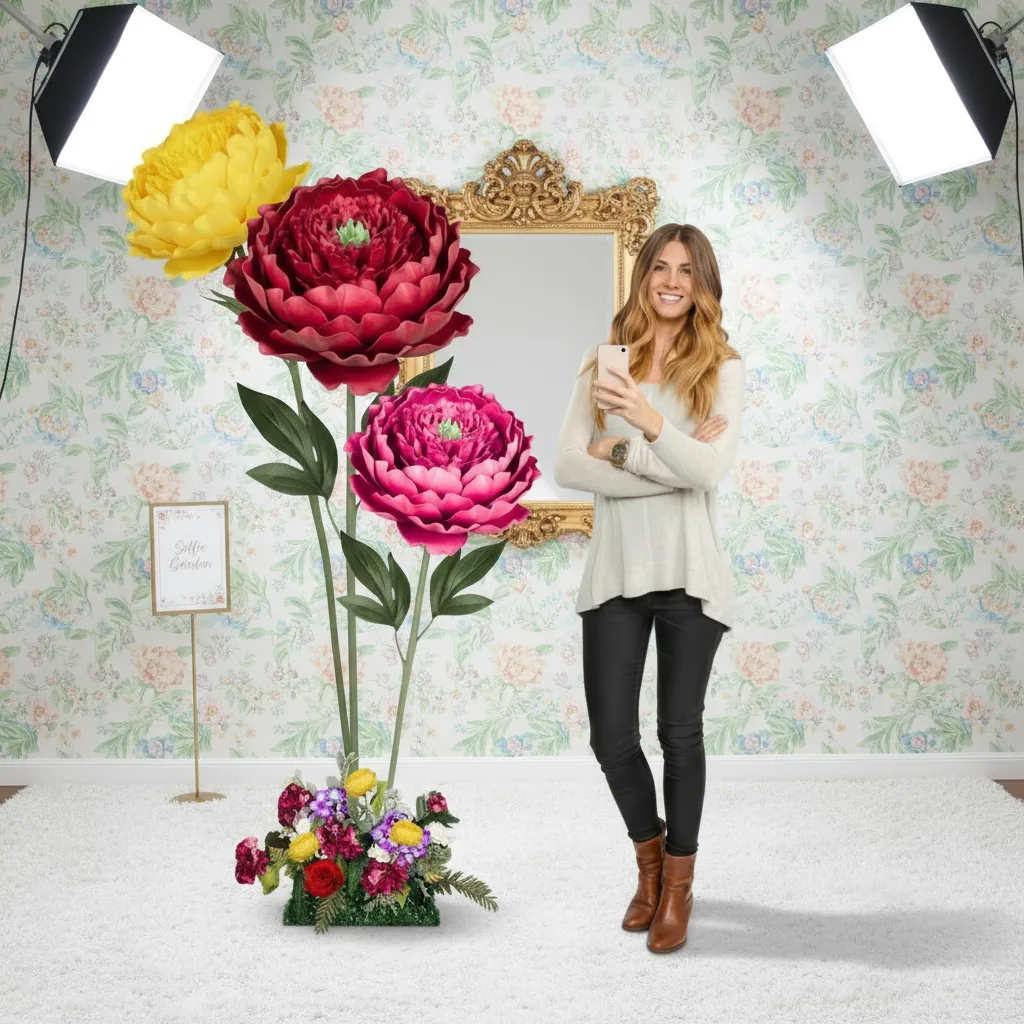
For a standard 8-foot wide backdrop, you can create a stunning asymmetrical display with as few as 3–5 giant foam flowers if you use strong size variation. A 5-foot anchor bloom, two 3-foot mid-size flowers, and two 18-inch accent blooms will fill the space beautifully without overcrowding.


If you want more density, our large floral arrangement ideas guide has some great examples of how to scale up without losing the asymmetrical feel.

Absolutely — in fact, they're often *more* appropriate for high-end events than traditional symmetrical designs. According to WeddingWire's trend data, organic and asymmetrical installations are consistently among the top-requested looks for luxury weddings and corporate events.

The key is execution. High-quality materials, intentional color palettes, and careful placement are what separate a luxury asymmetrical installation from a thrown-together one. Giant EVA foam flowers, properly painted and finished, absolutely hold their own in premium event spaces — we've had our pieces used by Disney and Dolce & Gabbana, so I can say that with confidence.


Can I make an asymmetrical arrangement with a DIY kit?

Yes, and honestly, our kits are designed with exactly this kind of flexibility in mind. Because each flower is a separate, freestanding or wall-mountable piece, you can arrange them in any configuration you want. There's no pre-set layout you have to follow.

Our bundle kits (8–12 flowers, $350–$600) give you the most flexibility for asymmetrical designs because you get a wide range of sizes to work with. The size variation is built right into the bundle.


Shoot from a slight angle rather than dead-on. A straight-on shot of a symmetrical arrangement works great — but for asymmetry, a 15–30 degree angle captures the diagonal flow and depth much better. It also shows the layering, which is a huge part of what makes these installations look so dimensional.

Natural light from the side is your best friend here. It creates shadows that emphasize the petal texture and the depth between layers. If you're shooting for social media or a portfolio, that side-lit, slightly angled shot is the one you want. Check out our guide to the best photo booth backdrops of 2026 for more photography-focused layout tips.


You want something with strong visual presence — a peony, dahlia, or oversized ranunculus shape works beautifully as an anchor because the layered petals create density and texture that commands attention. These shapes also have natural visual weight that reads clearly even from a distance.

Avoid using a very open, airy flower shape (like a cosmos or single-petal daisy) as your anchor — those shapes work better as accent blooms because they don't have enough visual mass to hold the composition together from the dominant position.


If you've made it this far, I genuinely hope you're feeling excited rather than overwhelmed. Asymmetrical design has this reputation for being complicated, but once you internalize a few key principles — odd numbers, diagonal flow, size hierarchy, negative space — it starts to feel completely natural. More natural than symmetry, honestly. Start simple. Three flowers. One big, one medium, one small. Place them off-center, let them breathe, and step back. I promise you'll surprise yourself. And when you're ready to grab your materials, head over to our shop at Amazing Giant Flowers — I'd love to help you build something incredible.

Ready to Create Something Amazing?

Browse our collection of giant flower kits and start your next project.

Shop All Flowers