Best Supplies for Foam Flowers for Beginners and Repeat Makers
Key Takeaways
Real talk? The design is only half the battle. I've seen beautiful flower templates completely ruined by cheap foam that cracked, or petals that wouldn't hold their curl because the glue wasn't strong enough.
Your supplies are the foundation. Get them right and everything else clicks into place.
According to Statista, the US craft industry generates over $44 billion annually — and a huge chunk of that is hobbyists and small business owners buying supplies that don't perform the way they expected. That's a lot of wasted money.
Let's start here because this is the most important decision you'll make. The foam you choose affects how your petals curl, how they hold up over time, and how easy they are to cut and shape.
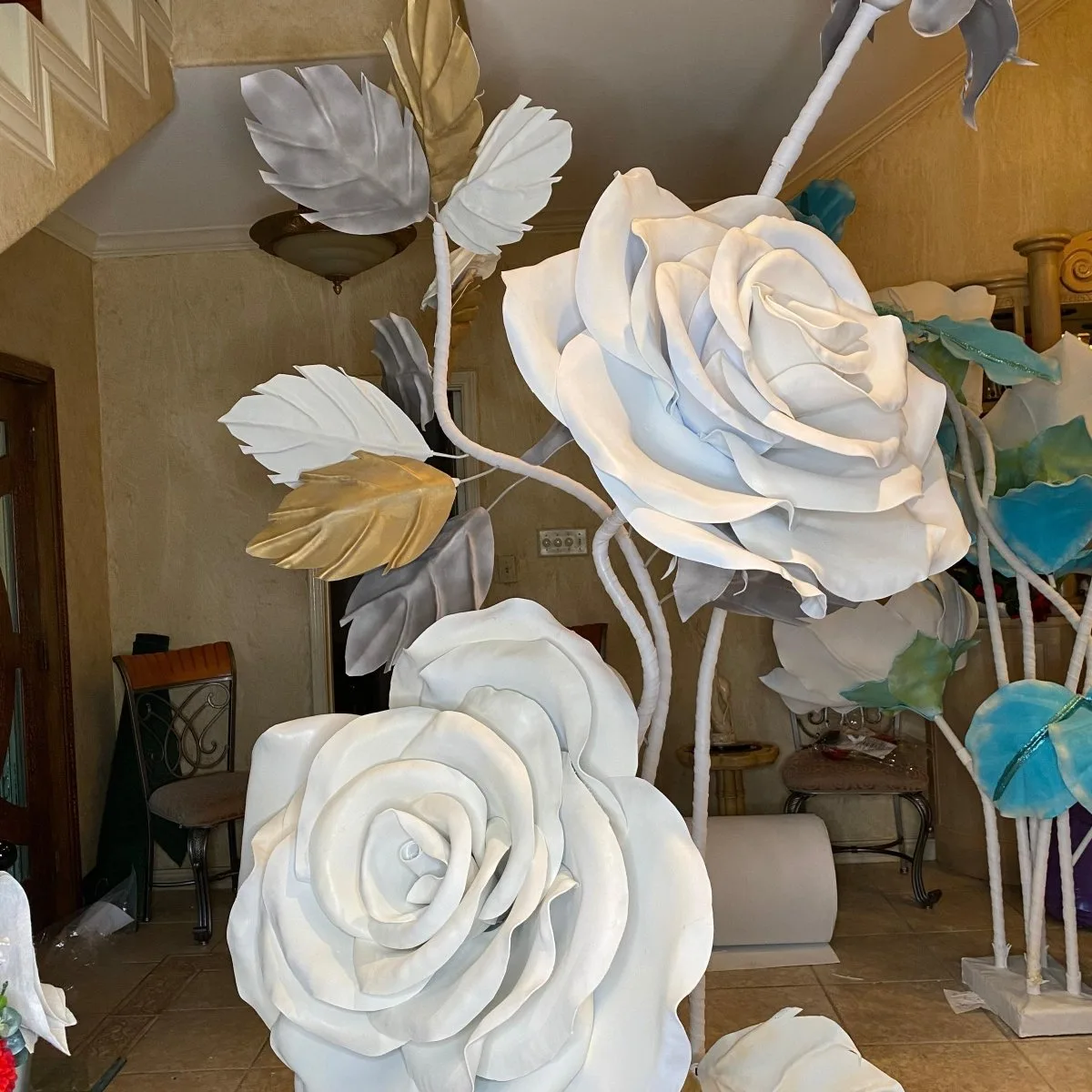
EVA foam (Ethylene-Vinyl Acetate) is what we use for every single flower at Amazing Giant Flowers. It's flexible, lightweight, and — critically — it responds to heat. That means you can curl petals with a heat gun or even a hair dryer and they'll hold that shape permanently.
For giant flowers, you want 2mm thickness for delicate petals, 4mm for standard petals, and 6mm for structural base layers or thick, statement blooms.
I go deep on all the foam options in A Crafter's Guide to Every Type of Foam for Giant Flowers — definitely worth a read if you want the full breakdown.
Foam Board: A Supporting Player
Foam board (the kind you find at dollar stores) is great for backings, signs, and structural elements — but it's not ideal for petals. It snaps instead of bending, which means your flower looks flat and stiff.
If you do use foam board for any part of your project, check out Your Guide to Flawless Foam Board Paint Finishes for tips on getting a smooth, professional surface.
Thin craft foam sheets (the kind sold in multipacks at Michaels) are tempting because they're cheap. But they're usually only 1–2mm thick and don't have the same density as quality EVA foam.
For small flowers under 12 inches, they can work. For giant 2–5 foot blooms? They'll look floppy and won't hold their shape under the weight of multiple layers.
I cannot tell you how many times I've seen beautiful flowers fall apart at events because someone used the wrong glue. This section might be the most important thing you read today.
For assembling giant foam flowers, high-temperature hot glue is the MVP. You want a gun that's at least 60 watts — the low-temp mini guns you find at the dollar store just don't generate enough heat to create a strong bond with thick EVA foam.
I use a full-size trigger-feed glue gun with a precision nozzle for detail work and a standard nozzle for large petal attachment. The difference in control is massive.
One thing to watch: high-temp glue can warp thin 2mm foam if you hold it in one spot too long. Work quickly and move the gun as you apply.
Contact Cement: For Permanent, Flat Bonds
Contact cement (like Barge or DAP Weldwood) is incredible for bonding large flat surfaces — think gluing a foam sheet to a backing board, or laminating two foam layers together. It creates an almost unbreakable bond.
The downside? It's not repositionable. Once those two surfaces touch, you're committed. So measure twice, glue once.
Honestly? Skip regular craft glue (Elmer's-style) entirely for foam flowers. It takes forever to dry and the bond is weak under any stress. Same goes for rubber cement — it yellows, it peels, and it smells terrible.
Super glue (cyanoacrylate) can work in a pinch for tiny repairs but it makes EVA foam brittle at the bond point, which means it'll snap under pressure.
A beautiful flower with a floppy stem is a sad flower. Getting the structural support right is what separates a professional-looking display from a craft-fair-gone-wrong situation.
Bendable pipe stems are exactly what they sound like — thick, flexible stems that you can shape into any angle. They're what we use in our kits at Amazing Giant Flowers, and they make freestanding flowers actually stand up straight without wobbling.
For flowers 2–3 feet tall, a single 36-inch bendable stem is usually sufficient. For 4–5 foot statement flowers, you'll want to double up or use a rigid PVC pipe insert for extra support.
Floral Wire: For Detail Work
Floral wire (18–24 gauge) is perfect for smaller internal structures — like wiring individual petals to a center, or creating a wire armature for a flower that needs to be attached to an arch or backdrop frame.
It's not strong enough to support a giant freestanding flower on its own, but as a secondary support system inside a flower? Brilliant.
For outdoor events or flowers that need to stand in planters or buckets, I always recommend a 1/2-inch PVC pipe as the main stem. Slide your decorative bendable stem over it, and you've got a flower that won't tip over even in a light breeze.
Wooden dowels work similarly indoors — just make sure you're using at least a 3/8-inch diameter for anything over 2 feet tall.
When I first started making giant flowers, I ruined so many petals with the wrong scissors. The edges were jagged, the curves weren't smooth, and the whole flower looked homemade in the bad way. Here's what I learned.
A sharp craft knife on a self-healing cutting mat is hands-down the most precise cutting method for EVA foam. You get clean edges, perfect curves, and consistent petal shapes every single time.
Replace your blades often. A dull blade drags and tears the foam instead of slicing it cleanly. Blades are cheap — use a fresh one for every major project.
Scissors: The Right Pair Matters
Sharp fabric scissors or heavy-duty craft scissors work well for curved petal cuts in thinner foam (2–3mm). Do NOT use regular paper scissors — they'll compress the foam as they cut, leaving a pinched, uneven edge.
I keep a dedicated pair of 8-inch Fiskars just for foam. Never used for anything else. They stay sharp for years that way.
If you're making flowers in volume, a Cricut Maker or Silhouette Cameo with a foam-compatible blade is a total game changer. You can cut identical petals in minutes instead of hours.
The catch? These machines work best with foam up to 3mm thick. For thicker EVA, you're back to hand-cutting. Still, for production runs, it's worth the investment.
Painting foam flowers is optional — many of our kits come in gorgeous pre-colored foam — but if you want a custom color or a painted effect, here's what you need to know.
Acrylic paint adheres to EVA foam beautifully. It's flexible when dry, so it won't crack when your petals bend. Use a soft-bristle brush or a foam roller for smooth coverage.
For large petals, thin your acrylic slightly with water for a more even coat. Two thin coats always beats one thick coat that peels.
I've written a full guide on this — A Crafter's Guide To Painting On Foam Core — if you want to go deep on technique.
Spray Paint: Proceed With Caution
Some spray paints are totally fine on EVA foam. Others will literally melt it. The key is to look for spray paints labeled "safe for foam" or test on a scrap piece first.
Rust-Oleum 2X Coverage and Krylon COLORmaxx are generally foam-safe. Anything with strong solvents — like lacquer-based sprays — will eat right through your petals. Don't learn this the hard way.
Want a metallic or pearlescent look? DecoArt Dazzling Metallics and Martha Stewart's multi-surface metallic paints both work beautifully on foam. I've used these for wedding flowers and the results look genuinely luxurious.
For a matte sealed finish that protects your paint, a coat of Mod Podge Matte over dried acrylic is my go-to. It adds durability without adding shine.
This is where the magic happens. Heat is what transforms flat foam sheets into dimensional, realistic-looking petals. It's also where beginners get intimidated — but it's genuinely easier than it looks.
A heat gun (around 300–400°F) is the professional tool for shaping EVA foam petals. Hold it 3–5 inches from the foam, move it in small circles, and the foam will soften within seconds. Then curl, cup, or bend the petal and hold it until it cools — usually 10–15 seconds.
Don't hold the heat gun in one spot. You'll scorch the foam and it'll turn brown and bubble. Keep it moving.
Hair Dryer: The Beginner-Friendly Option
A regular hair dryer on high heat works for thin 2mm foam and is much more forgiving than a heat gun. It takes a little longer to soften the foam, but the risk of scorching is almost zero.
If you're just starting out, start with the hair dryer. Graduate to the heat gun once you've got a feel for how foam responds to heat.
Ok, I'm obviously biased here because we sell kits. But I'm going to be honest with you anyway, because that's how I roll.
According to a WeddingWire survey, couples spend an average of $1,500–$2,500 on wedding florals. Giant foam flowers can replicate that look for a fraction of the cost — but only if you're not wasting foam on bad cuts and learning curves.
Beyond the big categories, there are a handful of smaller supplies that make a huge difference. These are the things I always have on my workbench.
I get asked this constantly. Here's my honest breakdown of where to shop depending on what you need.
For EVA foam sheets and bendable stems: Our Amazing Giant Flowers shop carries the exact materials we use in our kits — pre-sourced for giant flower making, not generic craft foam. No guessing about quality.
For tools (heat gun, scissors, craft knife): Amazon, Home Depot, or Michaels all carry what you need. For heat guns specifically, look for brands like Wagner or Black+Decker — reliable, affordable, and widely available.
For paint and finishing supplies: Michaels and Hobby Lobby are your friends. Sign up for their coupons — you can regularly get 40–50% off a single item, which adds up fast when you're buying acrylic paint sets.
According to IBISWorld, the US craft store industry is worth over $16 billion — meaning there's no shortage of options. But more options means more confusion. Stick to the categories I've outlined and you won't go wrong.
Frequently Asked Questions
What is the best foam to use for giant flowers?
EVA foam is the best material for giant foam flowers. It's flexible, lightweight, heat-shapeable, and durable enough to last through multiple events. For petals, use 2mm–4mm thickness. For structural base layers, go up to 6mm.
Avoid regular craft foam sheets for large flowers — they're too thin and floppy to hold shape at scale.
You can, but a high-temperature glue gun (60W+) will give you a much stronger bond. Low-temp mini guns don't generate enough heat to fully melt into thick EVA foam, which means joints can pop apart under stress — especially in warm environments like outdoor events.
Invest in a full-size trigger-feed gun. It's one of those tools you'll use for every project.
Heat is the secret. Use a heat gun or hair dryer to warm the EVA foam until it softens (usually 5–10 seconds), then curl or cup the petal with your hands and hold it until it cools. The foam will retain that shape permanently once it cools.
Beginners should start with a hair dryer — it's more forgiving. Once you're comfortable with how the foam responds, graduate to a heat gun for faster, more dramatic shaping.
What paint works best on EVA foam flowers?
Acrylic paint is the best choice — it's flexible, adheres well, and won't crack when petals bend. Apply in two thin coats with a soft brush or foam roller. Seal with Mod Podge Matte for durability.
If you use spray paint, test on a scrap piece first. Some spray paints contain solvents that will melt EVA foam. Look for foam-safe options like Rust-Oleum 2X Coverage.
For your first few flowers, a pre-cut kit is almost always the better value when you factor in the cost of wasted foam, tools, and time. Raw supplies have a lower material cost but require a significant time investment and some trial and error.
High-volume makers (20+ flowers per month) will eventually save money buying bulk raw materials — but the setup cost for tools like a Cricut Maker can be $400–$500 upfront.
With proper care, EVA foam flowers can last 2–5 years or longer. They're not affected by humidity the way paper flowers are, and they don't wilt like fresh flowers. Store them in large boxes or hanging to prevent crushing, and keep them out of direct sunlight to preserve color.
According to The Knot, fresh wedding flowers last 5–7 days on average — making foam flowers a dramatically more cost-effective investment for anyone who wants lasting decor.
I hope this guide saves you time, money, and a few frustrated afternoons at the craft store. Getting the right supplies truly is the difference between a flower you're proud to display and one that ends up in the trash after a weekend. If you're ready to skip the supply-sourcing headache and jump straight to making, check out our full shop at Amazing Giant Flowers. Everything is pre-sourced, tested, and designed to work together — so all you have to do is create. And if you want to see what's possible with these materials, our DIY Giant Flower Backdrop guide is a great next step. What's the one supply you've been most confused about? Drop it in the comments — I read every single one.
Ready to Create Something Amazing?
Browse our collection of giant flower kits and start your next project today.