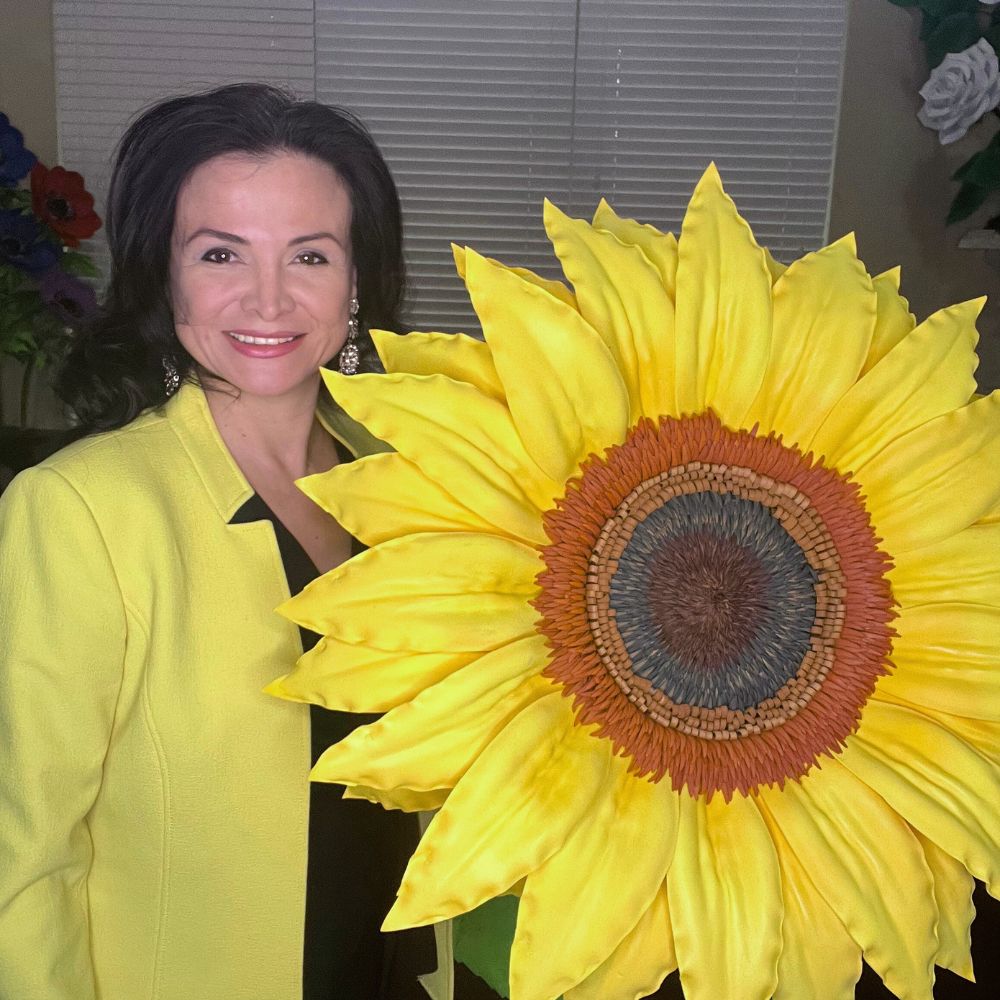
Giant Sunflower DIY: Build a Cheerful 4-Foot Foam Sunflower

If you've been searching for a giant sunflower DIY foam tutorial that actually works β not the kind where you end up with a sad, floppy mess that looks nothing like the Pinterest photo β you're in the right place. I've made hundreds of these. I've also ruined plenty of them along the way, so I'm going to save you from every mistake I made so yours comes out gorgeous on the first try.
Sunflowers are honestly my favorite flower to build in giant form. There's something about that deep golden yellow against a rich chocolatey brown center that just makes people stop and stare. I've had grown adults gasp when they walk into a room decorated with these. That reaction never gets old.
By the end of this tutorial, you'll know exactly how to build a 4-foot freestanding foam sunflower from scratch β which foam to use, how to cut and shape every petal, how to build that iconic center, and how to put it all together so it actually holds up. Let's get into it.
Real talk? I've seen people try to build giant sunflowers out of crepe paper, cardstock, felt, and even fabric. And while some of those can look pretty, none of them hold up the way EVA foam does.
EVA foam β ethylene-vinyl acetate β is the same material used in high-end cosplay armor, shoe soles, and professional stage props. It's lightweight, flexible, and when you hit it with a heat gun, it curves and shapes exactly like a real petal. That's the magic.
When I first started making giant flowers years ago, I was using crepe paper because that's what I saw everywhere. Honestly? It was a nightmare. The petals would droop, they'd tear if someone so much as breathed on them, and forget about using them outdoors. One humid Houston afternoon and they were done.
EVA foam changed everything for me. It's weather-resistant, reusable, and incredibly durable. I've had clients use their giant foam sunflowers for multiple events over several years. That's just not possible with paper.
According to IBISWorld, the US floral industry is worth over $7.9 billion β and a huge chunk of that is event dΓ©cor. More and more event planners and DIY brides are turning to giant foam flowers because fresh florals are expensive and they wilt. A Brides.com survey found couples spend an average of $2,000β$2,500 on wedding flowers. A giant foam sunflower you build yourself? Under $30 in materials.
Here's what you need to know about foam thickness for this project:
You can grab all of these foam thicknesses right from our shop. I source specifically for giant flower projects, so the density and texture is exactly right β not too stiff, not too spongy.
Ok, this is where a lot of people go wrong. They dive in without gathering everything first and then they're running to the craft store mid-project with paint-covered hands. Let me save you that trip.
Here's your complete materials list for one 4-foot giant foam sunflower:
If you want to skip sourcing everything separately, our bundle kits include pre-cut foam pieces, stems, and a video tutorial that walks you through the whole process. But if you're a from-scratch kind of person, keep reading β I've got you covered.
One thing I want to mention before we start cutting: work in a ventilated space when you're using the heat gun. EVA foam is non-toxic, but you still don't want to be breathing in hot foam fumes in a closed room. Open a window, turn on a fan. Your future self will thank you.
Alright, here's where it gets really fun. We're building this flower in four stages: cutting the petals, shaping with heat, building the center, and assembly. Don't rush any of these stages. The shaping step especially β that's where the magic happens.
Start by making your petal templates out of cardstock. For a 4-foot sunflower, you want two sizes: the outer ray petals at 18 inches long, and the inner petals at 12 inches long. Both should have that classic elongated teardrop shape with a slight point at the tip.
Trace your template onto the 2mm yellow foam and cut. You'll need 24-28 outer petals and 16-20 inner petals. Yes, that's a lot. Real sunflowers are dense. That's what makes them so stunning.
Cut your center disc from the 10mm brown foam. For a 4-foot flower, the center should be about 14-16 inches in diameter. Trace around a large bowl or use a compass. Cut two of these β you'll layer them for extra depth.
Here's a tip I wish someone had told me early on: cut all your pieces before you pick up the heat gun. Once you start shaping, you get into a flow state and you don't want to break it by going back to cut more petals. Batch your prep work. It makes the whole build faster and more enjoyable.
This is the step that separates a flat, craft-fair-looking flower from something that genuinely looks alive. Heat shaping gives your petals that natural curve, that slight ripple at the edges, that movement.
Hold your heat gun about 3-4 inches from the foam surface. Move it in slow, sweeping motions β never hold it in one spot or you'll scorch the foam. You'll see the foam start to soften almost immediately.
While the foam is warm and pliable, curve it over your hand or a rounded object. For sunflower petals, I like a gentle upward curve along the length of the petal, with the edges curling slightly inward. Hold the shape for about 10-15 seconds until it cools and sets. It holds permanently. Every time.
For the inner petals, I add a little more drama β a sharper curve and a slight twist at the tip. This mimics how real sunflower petals overlap and layer near the center. Little details like this are what make people ask "wait, is that real?" Check out our full post on heat gun techniques for shaping foam flower petals if you want to go deep on this skill β it applies to every giant flower you'll ever make.
Once all your petals are shaped, lay them out in two groups β outer and inner. Step back and look at them. Discard any that look too flat or uneven and reshape them. This is your quality control moment. Don't skip it.
The center is honestly what makes or breaks a giant sunflower. Get this right and the whole flower comes alive.
Take your two 14-16 inch brown foam discs and glue them together with hot glue. Press firmly and let them bond completely. This gives you a center that's about 20mm thick β substantial enough to look real.
Now for the texture. Real sunflower centers have that beautiful geometric pattern of seeds. To replicate this, I use a ballpoint pen or a dull pencil to press small circular indentations all over the surface of the warm foam. You can also use the end of a paintbrush. Work in a spiral pattern from the outside in β this matches the actual Fibonacci spiral of a real sunflower seed head. Yes, I'm a flower nerd. No, I'm not sorry.
According to National Geographic, sunflower seed heads follow a precise Fibonacci spiral pattern β the same mathematical sequence found throughout nature. Replicating even a loose version of this pattern makes your foam center look dramatically more realistic.
Paint the center disc with dark brown acrylic as your base. Let it dry, then dry-brush a layer of burnt orange across the raised texture. Finish with a very light dry-brush of golden yellow on the highest points. This three-color technique creates incredible depth and realism.
While that dries, paint your petals. Use bright golden yellow as your base on both sides. Once dry, add a streak of burnt orange or rust along the base of each petal β the part that will be near the center. This gradient is subtle but it makes the whole flower look dimensional instead of flat.
Here's where your flower starts to actually look like a sunflower. Exciting moment. I still get a little thrill every time I hit this stage, even after hundreds of builds.
Start with your bendable pipe stem. If you're making this freestanding, your stem needs to go through or attach to the back of the flower head and then down into a base. I recommend a PVC pipe base filled with sand or concrete for anything 3 feet and taller β it keeps the flower stable even with some movement around it.
Cut a small hole in the center of your foam disc, just large enough for the stem to pass through. Thread the stem through and secure it on the back with hot glue and a small foam patch. Make sure this bond is solid β this is the structural anchor of your whole flower.
Now start gluing your outer petals to the back of the center disc. Work in a circle, evenly spacing petals around the full 360 degrees. Apply a generous bead of hot glue along the base of each petal and press firmly for 15-20 seconds. Overlap the petals slightly as you go β sunflowers don't have perfectly spaced petals, and neither should yours.
Once your outer ring is complete, add your inner petals on top, nestled between the outer petals and angled slightly upward. These should sit closer to the center and point more toward the viewer. The overlap between layers is what creates that full, lush look.
Step back and assess. Rotate the flower slowly. Are there any gaps? Fill them with smaller petal pieces. Is the center sitting flat and centered? Good. Is your stem secure? Give it a gentle tug. If anything feels loose, reinforce with another pass of hot glue.
A The Knot report found that DIY wedding dΓ©cor can save couples anywhere from 30β70% on their total decoration budget. Giant foam sunflowers are one of the most impactful DIY projects you can tackle β high visual payoff, relatively low cost, and they last for years.
If you're planning to use your sunflower as part of a larger installation β like an arch or a backdrop β I'd love for you to check out our guide on giant foam flowers for wedding arches and our full tutorial on DIY giant flower backdrops for photos. Sunflowers look absolutely incredible in both of those setups.
You've built your flower. Now let's make sure it looks its absolute best and lasts as long as possible.
First β seal your paint. Even if you're using this indoors, a light coat of matte acrylic sealant protects the paint from scuffs and handling. If it's going outside, use a UV-resistant sealant. Houston summers are brutal and UV will fade yellow foam faster than anything.
For display, a 4-foot sunflower works beautifully as:
Now let me be honest about the mistakes I see people make most often, because I want yours to turn out perfect:
According to Statista, the global DIY crafts market is projected to reach $50.9 billion by 2024 β and giant paper and foam flowers are one of the fastest-growing segments within event DIY. You're not just making something pretty. You're part of a massive creative movement.
One more thing: if you've never worked with EVA foam before, don't let the learning curve intimidate you. According to a HGTV survey on DIY home dΓ©cor trends, over 60% of first-time crafters said their project turned out better than expected when they followed a detailed tutorial. You've got this.
And if you want to take this even further β build a whole installation, create an arch, do a full sunflower field backdrop β our guide to freestanding giant flower arrangements for events is a great next step. There's also a lot of overlap with our oversized flower arch backdrop tutorial if you're thinking bigger.
I genuinely love seeing what people make with these techniques. There's something so special about building something this big and beautiful with your own hands β something that makes an entire room feel transformed the moment you walk in. That's what giant flowers do. And sunflowers especially have this warmth and joy to them that's just impossible to replicate with anything else.
If you're ready to grab your materials and get started, head over to our shop β everything you need for this project is there, including pre-cut kits if you want to skip the cutting stage and jump straight to the fun part. And if you make one, please share it with me. Seriously. Nothing makes my day like seeing a gorgeous giant sunflower that someone built from scratch.
```Ready to Create Something Amazing?
Browse our collection of giant flower kits and start your next project.
Shop All Flowers