EVA Foam for Cosplay & Props: One Roll, Endless Builds
If you've been deep in the eva foam cosplay rabbit hole for any amount of time, you already know: the material makes or breaks the build. I've watched so many talented cosplayers waste hours fighting with cheap, inconsistent foam — warping at weird angles, tearing mid-cut, refusing to hold a heat shape. It's genuinely heartbreaking when the skill is there but the material lets you down.
Here's what changed everything for me. When I started Amazing Giant Flowers, I wasn't thinking about cosplay at all — I was obsessed with building massive blooms for weddings and events. But the foam I sourced? It was so good that cosplayers started finding us. They'd order a roll for a flower project and come back saying, "Wait, this is the best EVA I've ever used for armor." That feedback stopped me in my tracks.
So this post is for you — the builder, the maker, the person who stays up until 2am hot-gluing pauldrons and then wonders why craft-store foam sheets cost so much for so little. Let's talk about buying smarter, building better, and getting way more out of every dollar you spend on foam.
Key Takeaways
Let me just say it plainly: EVA foam is the closest thing to a magic material that crafters have. It's lightweight. It cuts clean. It heats and shapes with a basic heat gun. It takes paint beautifully. And when you seal it properly, it looks like metal, leather, stone — whatever you need it to be.
Ethylene-vinyl acetate — that's the full name nobody uses — is a closed-cell foam polymer. What that means for you practically: it doesn't absorb moisture, it holds its shape after heat-forming, and it's dense enough to feel substantial without being heavy to wear all day at a convention.
What Makes Quality EVA Different
This is where I get a little opinionated, because I've seen the difference firsthand. Cheap EVA foam has an inconsistent cell structure. You'll cut into it and find one section is spongy and the next is oddly stiff. That inconsistency shows up in your finished piece — uneven paint absorption, warping after heat shaping, edges that crumble instead of cutting clean.
Quality EVA has a uniform cell structure throughout the entire roll. Every cut feels the same. Every heat-shaped curve holds the same way. That consistency is what lets you replicate pieces — if you're building matched armor sets or multiples of the same prop, it's non-negotiable.
Different thicknesses do genuinely different jobs. Here's how I think about it:
I always tell people: buy at least two thicknesses for any serious build. Your base layer and your detail layer work together — that's what creates the depth and dimension that makes cosplay look professional instead of flat.
Ok, real talk. I know the craft store feels convenient. You grab a few sheets, you're in and out. But let's actually do the math here, because I think once you see it written out, you'll never go back.
A standard craft store EVA foam sheet runs roughly $1.50–$3.00 per sheet for the thin stuff, and that sheet is usually 9" x 12". For a full armor build — chest, back, pauldrons, gauntlets, greaves — you might blow through 30–50 sheets. That's $45–$150 just in material, for foam that's often inconsistent in quality.
A roll of quality EVA foam gives you dramatically more usable surface area at a fraction of the per-square-inch cost. And you're getting it in one consistent batch — same density, same thickness, same surface texture throughout. No more driving back to the store three times because you ran out mid-build.
Stop paying craft store prices per sheet. One roll of quality EVA foam covers an entire armor build — and then some. That's not just savings, that's creative freedom.
| Purchase Method | Typical Cost | Coverage | Consistency | Best For |
|---|---|---|---|---|
| Craft Store Sheets | $1.50–$3.00/sheet (9"×12") | 108 sq in per sheet | Variable batch to batch | Tiny test projects only |
| Roll Purchase (specialty supplier) | Much lower per sq ft | Full armor build + extras | Uniform throughout | Full builds, multiples, pro use |
| Sheet Pack (bulk craft store) | Moderate savings vs single sheets | Limited — still small sheets | Inconsistent | Small to medium projects |
| Amazing Giant Flowers EVA Roll | Best value per sq ft | Multiple builds per roll | Consistent, craft-tested | Cosplay, props, flowers, theater |
EVA Foam Cosplay Techniques That Actually Work
I'm not a cosplayer myself — I'm a flower person at heart — but I've learned so much from the cosplay community that has found their way to our foam. And the techniques they use? Honestly, they overlap with giant flower making more than you'd think.
This is where EVA foam becomes genuinely magical. Apply heat from a heat gun — typically around 250–300°F — and the foam becomes pliable. Shape it over a form, hold it for 10–15 seconds, let it cool, and it holds that shape permanently. Curved armor plates. Domed helmet sections. Organic flower petal curves. All of it comes from the same technique.
If you want to go deep on heat shaping specifically, I wrote a whole piece on heat gun techniques for shaping foam petals that covers the exact temperatures and timing I use — and it applies directly to armor work too.
💡 Pro Tip
Always heat the back side of your foam first when shaping curves. The back surface expands slightly faster, which naturally pulls the foam into a concave shape — perfect for armor pieces that need to conform to the body. For convex shapes like shoulder domes, heat the front face instead.
A sharp blade is non-negotiable. I mean it — change your X-Acto or utility knife blade more often than you think you need to. A dull blade drags and tears the foam cell structure instead of slicing it cleanly. That torn edge is nearly impossible to sand smooth and it shows under paint.
For straight cuts, use a metal ruler and score in one confident pass rather than sawing back and forth. For curves, a sharp pair of scissors works surprisingly well on thinner foam (2mm–4mm). For thicker foam, a band saw or hot wire cutter gives the cleanest results. I cover cutting techniques in depth over at The Best Way to Cut Foam for Flawless DIY Crafts — worth a read before you start any major build.
Sealing and Painting Your EVA Foam Cosplay Pieces
Raw EVA foam is porous at the surface level. Paint it without sealing and you'll use three times as much paint and still get an uneven finish. Seal first. Always.
Popular sealing options include Plasti-Dip, Mod Podge mixed with water, and Flexbond. Each has its trade-offs — Plasti-Dip gives you a rubbery texture that reads as leather beautifully, while Flexbond stays more flexible for pieces that need to bend. Once sealed, acrylic paints go on like a dream and you can layer metallics, washes, and dry-brushing to get incredible depth.
For paint technique specifics, Your Guide to Flawless Foam Board Paint Finishes has some great foundational tips that translate directly to EVA work.
Ok, this is where it gets really fun. Because here's something the cosplay community often doesn't realize when they first order from us: the same roll of EVA foam that builds your armor can build something completely wild and beautiful for an event, a photoshoot, or a theater production.
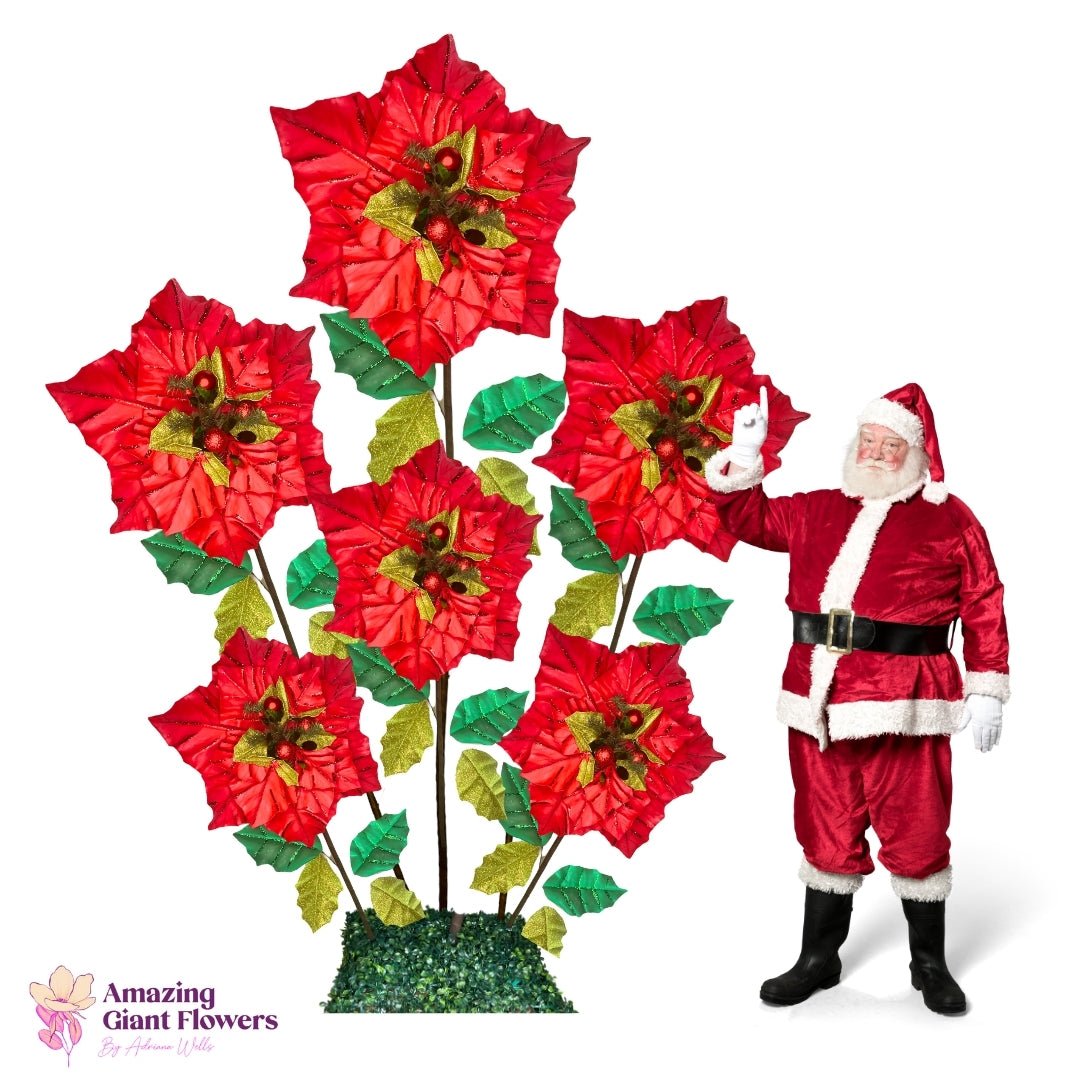
Giant decorative flowers — the kind that make people stop and stare at weddings, brand activations, and photo booths — are built from EVA foam. The petal shaping techniques are literally the same heat-and-form process you use for armor. The layering, the structural thinking, the paint finishing — all of it crosses over.
What Else Can You Build With Your Roll
- Giant decorative flowers for events, photoshoots, and backdrops — pair your foam with our flower molds for perfect petal shapes every time
- Theater props and set pieces — EVA foam paints to look like stone, metal, or wood and is light enough for actors to handle safely
- Classroom craft installations — teachers love it because it's safe, easy to cut with supervision, and holds up to handling
- Freestanding prop structures — combine foam with our bendable pipes for self-supporting installations that can go anywhere
- Photo booth backdrops — giant foam flowers make incredible backdrops; check out DIY Giant Flower Backdrop for Photos for the full how-to
I genuinely love that our foam lives at this intersection. A cosplayer orders a roll, builds their armor, has leftover material, and ends up making giant flowers for their friend's wedding. That happens more than you'd think, and it makes me so happy every time.
🌸 Ready to build something amazing?
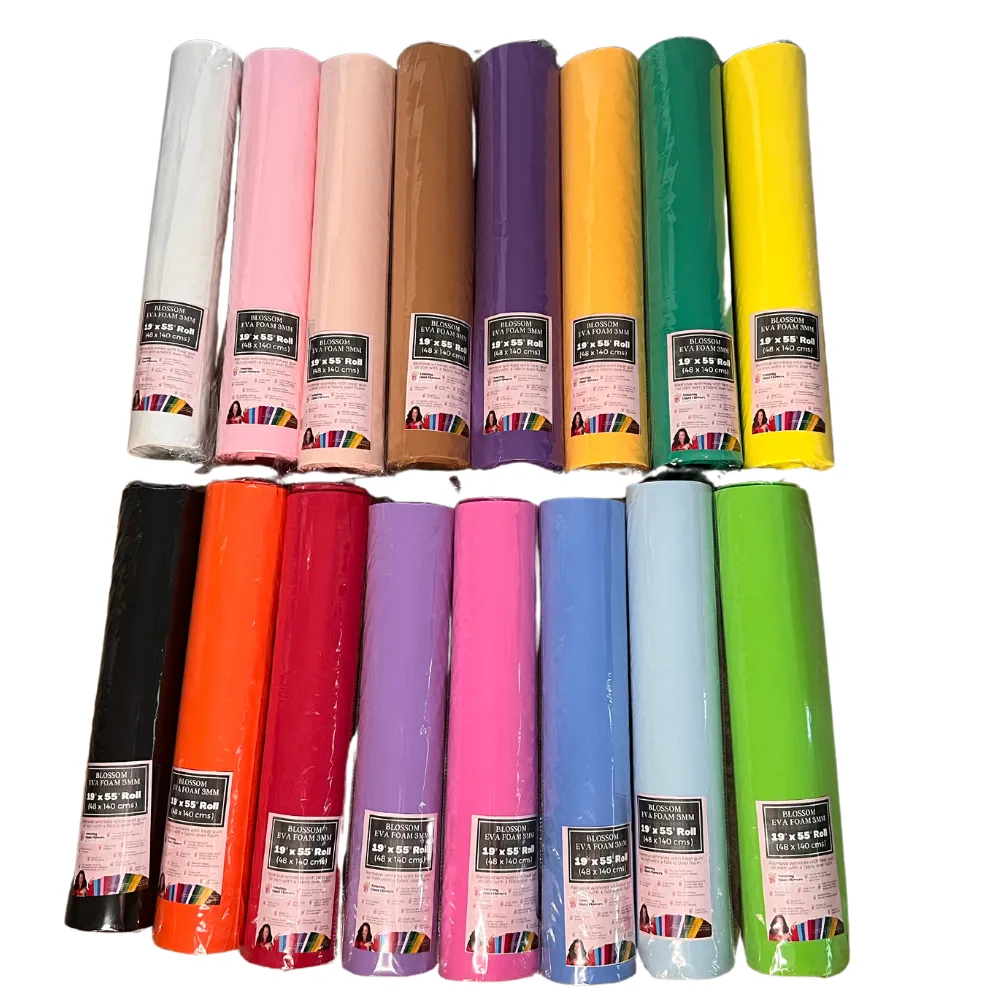
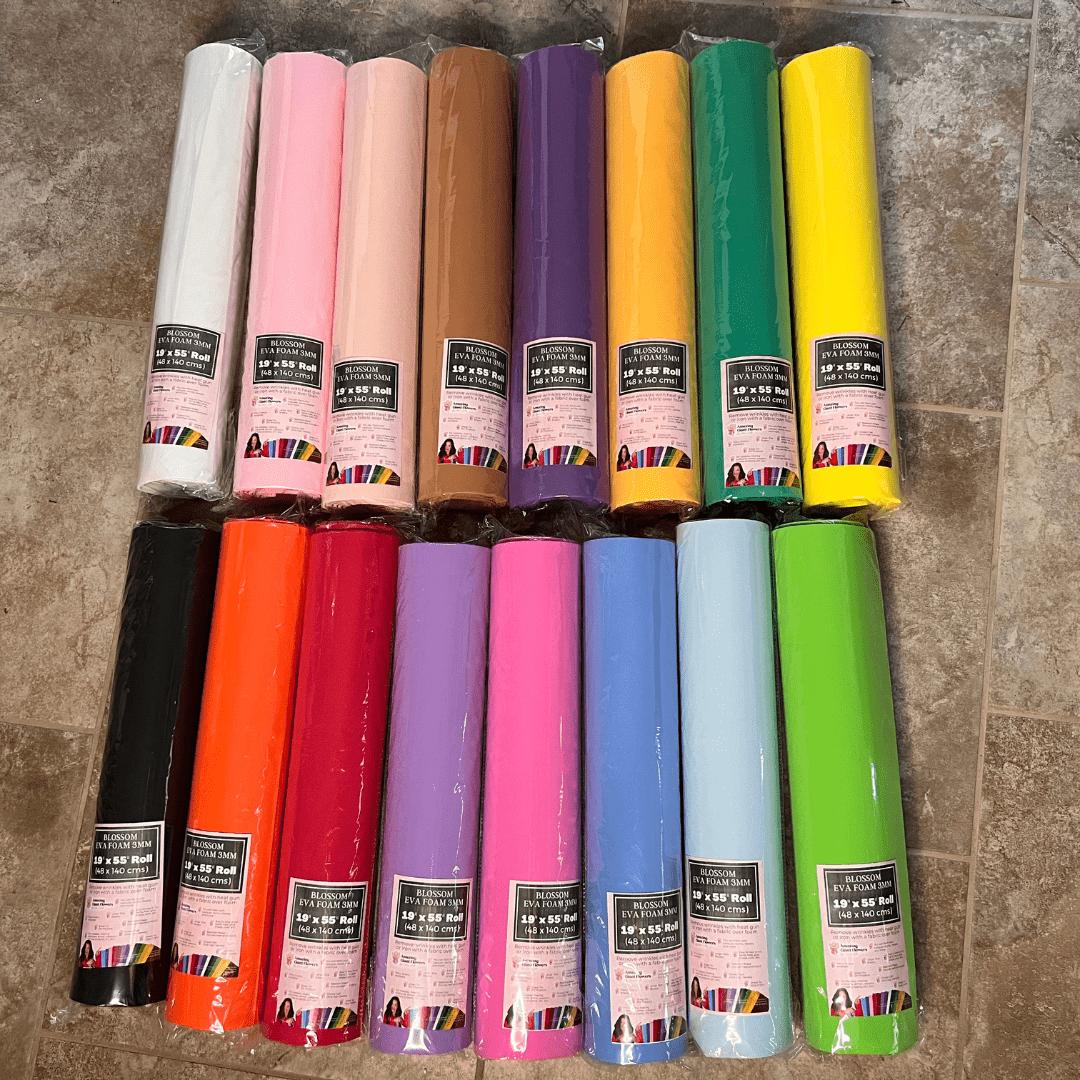
Browse our full EVA foam collection — rolls and sheets in 2mm through 10mm, ready to ship. And if you're thinking flowers too, our freestanding flower kits pair perfectly with the same foam.
I get asked this constantly: "Adriana, what thickness should I buy?" And my honest answer is: it depends on what you're building, but when in doubt, get a 4mm and a 6mm. Those two cover about 80% of cosplay and prop work.
The best cosplay builds I've seen treat foam thickness like a sculptor treats clay — they think in layers. A thick base layer (6mm–10mm) gives you structure and rigidity. A medium layer (4mm) adds dimension and shape. A thin detail layer (2mm) adds surface texture, beveled edges, and fine detail work that reads as engraving or inlay.
This same layered thinking applies to giant foam flowers — it's exactly how we build petals with depth and dimension rather than flat, boring shapes. If you're curious about how foam compares to other materials for decorative builds, Foam Flowers vs Paper Flowers: Which Is Better for Events? breaks it down really clearly.
These are not the same thing, and confusing them leads to bad material choices. Thickness is how tall the foam is — 2mm, 4mm, 6mm, 10mm. Density is how tightly packed the foam cells are. High-density EVA at 4mm will feel stiffer and more solid than low-density EVA at 6mm.
For cosplay armor, you generally want higher density — it holds shapes better after heat forming and doesn't compress when you bump into things at a con. For flower petals and softer prop work, slightly lower density gives you more graceful curves and flexibility.
Frequently Asked Questions
What thickness of EVA foam is best for cosplay armor?
For most armor builds, 6mm is your workhorse thickness — it's rigid enough to hold structural shapes but still heat-forms beautifully. Use 10mm for very large structural pieces like chest plates or helmet bases, and layer 2mm on top for surface detail work. If you're building something that needs to flex with your body (like a back piece or hip armor), 4mm gives you more movement without sacrificing too much structure.
Can I use the same EVA foam for both cosplay props and giant decorative flowers?
Ready to Create Something Amazing?
Browse our collection of giant flower kits and start your next project today.