Giant Bluebonnet: Crafting the Texas State Flower in Foam
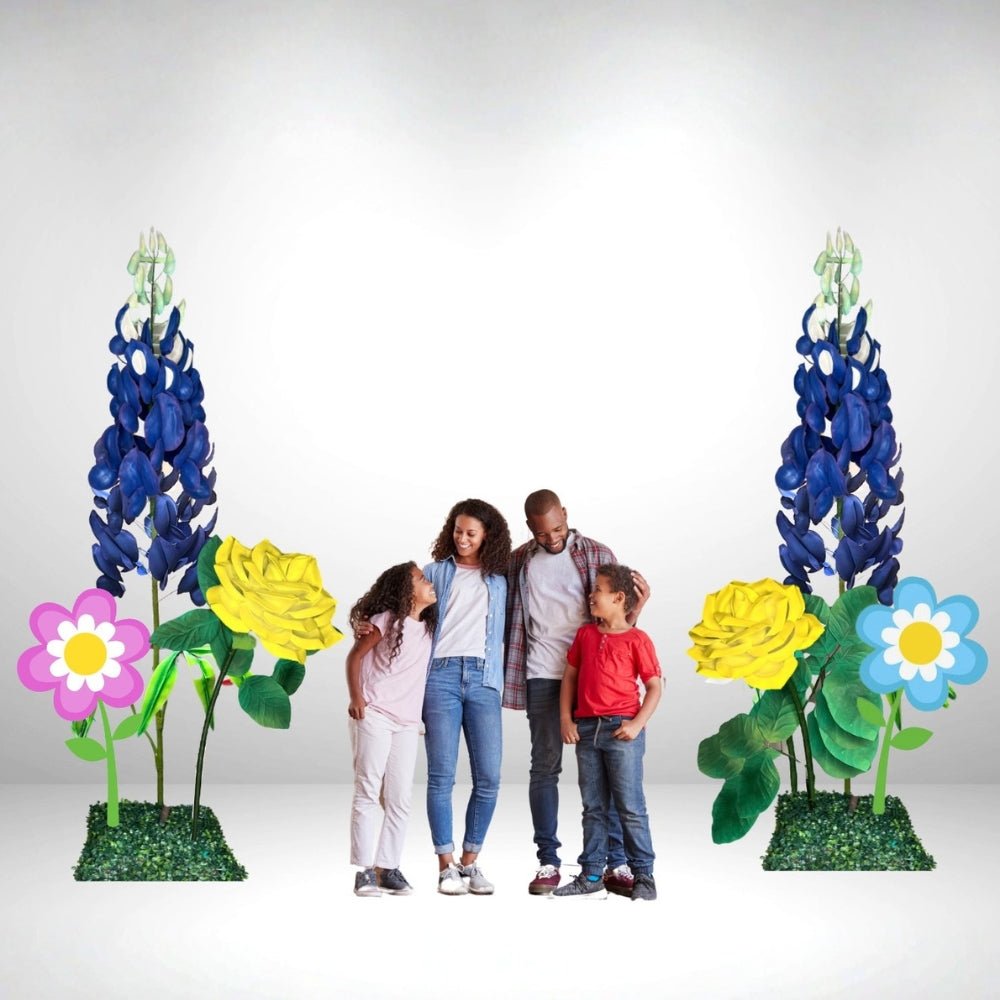
There's something about the giant bluebonnet Texas state flower that just stops people in their tracks. Maybe it's the color — that deep, moody violet-blue that you honestly can't find anywhere else in nature. Maybe it's the nostalgia. If you grew up in Texas, you know the drill: every spring, your mom pulled over on the side of Highway 290 and made you pose in a field of them for the annual family photo.
I've been making giant foam flowers for years now, and the bluebonnet is honestly one of my favorite builds. It's a little more technical than a rose or a dahlia, but the payoff? Absolutely stunning. We're talking about a flower that is instantly recognizable, deeply Texan, and wildly photogenic at 3 feet tall.
In this tutorial, I'm walking you through everything — the right foam, the right colors, how to shape those signature spiky petals, and how to assemble a finished giant bluebonnet that looks like it just bloomed out of the Hill Country. Let's get into it.
First, let me just say — fresh bluebonnets are notoriously impossible to use in arrangements. They wilt within hours of being cut. The Texas Department of Agriculture has even noted that bluebonnets don't transplant well, which is part of why they're so precious in the wild.
That's exactly why a giant foam bluebonnet is such a brilliant idea. You get all the beauty, zero wilting, and you can reuse it for years.
Think about the events where a giant bluebonnet makes perfect sense:
According to The Knot, floral installations are consistently among the top three most-requested wedding décor elements. And more couples than ever are choosing statement backdrops over traditional centerpieces.
Giant foam flowers fit that trend perfectly — and they cost a fraction of fresh floral installations. A professional fresh-flower backdrop can run $1,500 to $5,000+. A DIY foam version? You can pull it off for under $300 with the right supplies.
Ok, let me be really specific here because the bluebonnet has a very particular look. Getting the materials right is half the battle.
The real Lupinus texensis (that's the official botanical name for the Texas bluebonnet) has a very specific structure. It's a spike flower — meaning the blooms grow vertically along a central stem, with the youngest flowers at the very top. Each individual floret has a deep blue-violet color with a small white or cream "bonnet" at the center. That little white dot is the detail that makes it recognizable.
So when we build this in foam, we're not making one big bloom. We're building a cluster of smaller florets that stack up a central stem. It's a different construction than a peony or rose, and honestly, it's what makes this build so satisfying.
Here's your materials list:
Real talk? The color mixing is where most people get tripped up on this flower. Bluebonnets are NOT a true blue. They're a blue-violet with a slight cool undertone. If you go too blue, it looks like a generic flower. If you add just a touch of purple, suddenly it reads as a bluebonnet.
I always test my spray paint on a scrap piece of foam before committing to a full sheet. Takes two minutes and saves so much frustration.
Step-by-Step: Building Your Giant Bluebonnet
Step 1 — Cut and Shape Your Floret Petals
Each individual floret on a bluebonnet has 5 petals. The top petal (called the "banner" in botanical terms) is the largest — roughly 2.5 to 3 inches wide on a real flower. We're scaling up, so for a 36-inch finished flower, each banner petal should be about 8 to 10 inches wide.
The two "wing" petals on either side are slightly smaller — cut those at about 6 to 7 inches wide. The two bottom "keel" petals are the smallest and most cupped — cut them at 4 to 5 inches and use your heat gun to curl them into a tight cup shape.
You'll need to make 8 to 12 individual florets for a full-looking giant bluebonnet spike. I know that sounds like a lot, but each floret only takes about 10 minutes once you get into a rhythm.
Cut all your petals first before you start gluing anything. Lay them out on your table. Trust me — assembly goes so much faster when all your pieces are ready to go.
Once your petals are cut, grab your heat gun and work in small circular motions about 3 to 4 inches from the foam surface. You're warming the EVA just enough to make it pliable — not melting it. The banner petal should have a gentle backward curl at the top. The keel petals should cup forward, almost like tiny bowls.
Before you assemble anything, paint all your petals. Spray paint works best for the base color — hold the can about 12 inches from the foam and use light, sweeping passes. Two thin coats beats one thick coat every single time.
Let them dry completely. EVA foam dries fast — usually 15 to 20 minutes between coats.
Now here's the fun part. Take your white acrylic paint and a small detail brush. On each banner petal, paint a teardrop-shaped white spot right in the center — about 1 inch tall. This is the "bonnet" that gives the bluebonnet its name, and it is the single most important detail on this entire build.
Some people skip this step. Don't skip this step. It's what makes people gasp when they see it.
Once the white is dry, use a tiny bit of pale yellow paint at the very center of the white spot. In real bluebonnets, there's a tiny yellow marking that guides pollinators. Adding it to your giant version gives it an almost photorealistic quality that is genuinely jaw-dropping up close.
This is where your giant bluebonnet starts to look like an actual giant bluebonnet, and honestly this is where I get a little giddy every time.
Start by assembling each individual floret. Glue the 5 petals together at their bases around a small 1-inch foam circle. The banner goes at the top, wings on the sides, keel petals at the bottom. Use a generous bead of hot glue and hold each petal for a full 30 seconds before releasing — EVA needs a moment to bond properly.
Once all your florets are assembled, it's time to attach them to your central stem. This is the part that makes the bluebonnet different from every other flower we build.
Start at the top of the stem with your smallest, most tightly closed florets. Real bluebonnets have unopened buds at the tip — you can simulate this by making 2 or 3 florets with petals that barely open, petals curled almost completely closed.
Work your way down the stem, attaching florets in a spiral pattern every 3 to 4 inches. As you move toward the base, the florets should be more open and fully bloomed. By the time you reach the bottom third of the spike, your florets should be in full bloom position with petals spread wide.
According to the Lady Bird Johnson Wildflower Center, a mature bluebonnet spike typically carries 20 to 40 individual florets on a stem that reaches 10 to 16 inches tall. We're scaling that up dramatically, but keeping the same proportion and logic.
Wrap your stem in green floral tape as you go, covering the wire attachments and creating a clean, finished look. Pull the tape taut as you wrap — it activates the adhesive and gives you a smooth finish.
For a freestanding version, you'll want to check out our full guide on freestanding giant flower arrangements for events — it covers base options and weighting so your flower doesn't tip over.
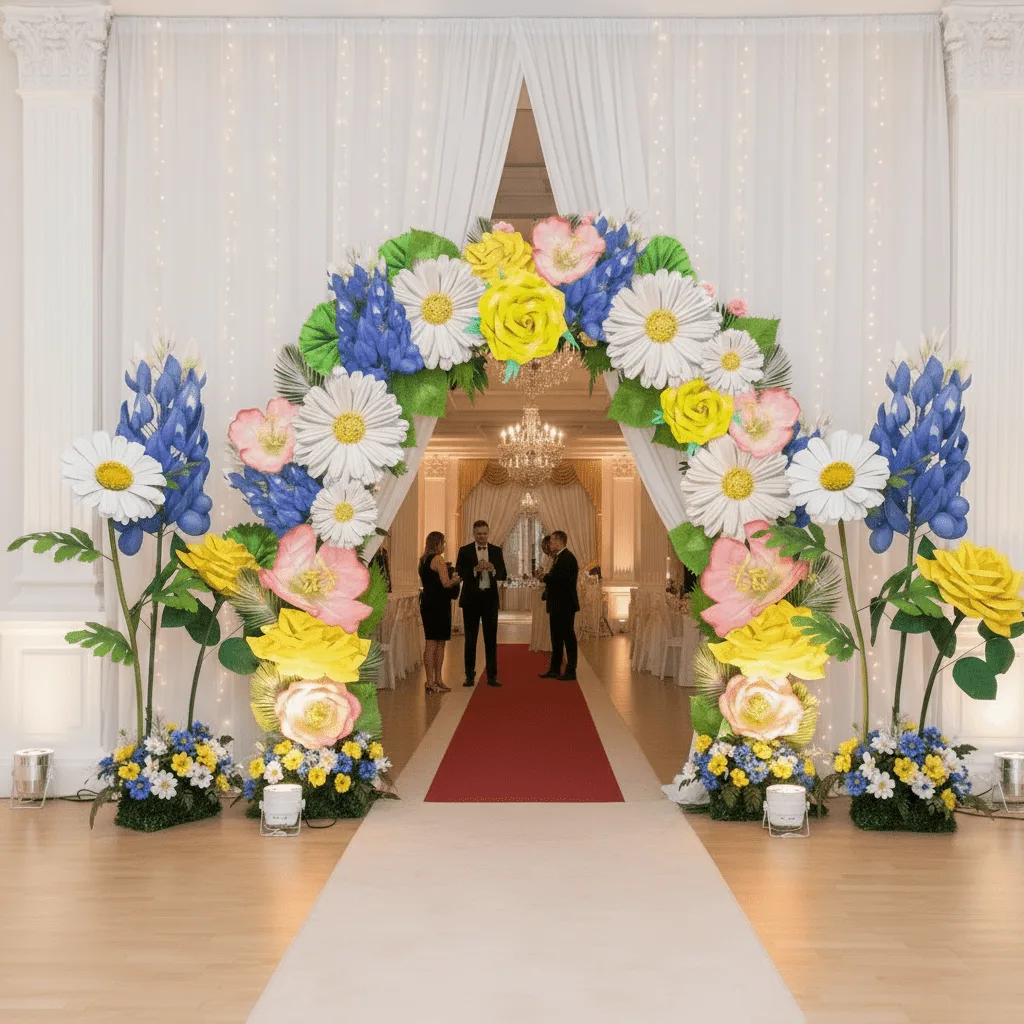
A single giant bluebonnet is gorgeous. A cluster of three is breathtaking. A full installation of seven to ten? People will literally stop mid-conversation to take a photo.
Here's how I like to style them:
A Brides.com survey found that couples spend an average of $2,000 to $2,500 on wedding flowers — and that's before installation costs. A DIY giant bluebonnet installation using our kits from Amazing Giant Flowers can give you a more dramatic, more photogenic result for a fraction of that budget.
If you're building this for a commercial space or retail display, giant bluebonnets are a natural fit for any Texas-based brand in March and April. According to IBISWorld, the US floral industry generates nearly $8 billion annually, and seasonal floral installations drive significant foot traffic for retail businesses. Our visual merchandising ideas for boutiques post goes deep on exactly how to use giant flowers to boost in-store engagement.
For corporate installations, the giant bluebonnet Texas state flower is honestly a no-brainer for any Texas company's spring event. It's instantly recognizable, it photographs beautifully, and it tells a story about where you're from. We've seen these used at brand activations, trade show booths, and product launches — and they always generate social media content organically. Check out our corporate event engagement ideas for more ways to use giant flowers in professional settings.
One more thing before I let you go — if you want to take this build even further, consider making a full wildflower meadow installation using a mix of giant bluebonnets, giant Indian paintbrushes, and giant sunflowers in a large floral arrangement style. It's one of the most Texas things you can possibly create, and every single time I've set one up, people have literally teared up. That's not an exaggeration. The nostalgia hits hard.
According to Statista, there are approximately 2 million weddings per year in the United States — and Texas consistently ranks among the top states for destination weddings. If you're an event planner or wedding decorator in Texas, having giant bluebonnets in your toolkit is genuinely a competitive advantage.
And for all my fellow Texans doing this for personal projects — a Mother's Day brunch with a giant bluebonnet centerpiece? She will cry. In the best way. Grab some ideas from our Mother's Day brunch decorations post and pair those bluebonnets with something soft and white for a really beautiful spring table.
I genuinely love this flower more than I can explain. It's Texas in a single image. It's spring road trips and wildflower fields and your mom yelling at you to stop squinting in the sun for the photo. Making it giant just amplifies all of that joy.
If you're ready to start building, head over to the Amazing Giant Flowers shop and grab your EVA foam supplies — everything you need is there. And if you make one, please send me a photo. I mean it. I want to see every single giant bluebonnet you create.
Ready to Create Something Amazing?
Browse our collection of giant flower kits and start your next project today.