How to Use Bendable Pipe Flower Stems for Stronger Builds
Key Takeaways
Here's what most tutorials don't tell you: the flower head is only half the battle. A stunning 4-foot peony means nothing if the stem collapses at your wedding reception.
When I first started making giant flowers, I tried everything — wooden dowels, PVC pipe, even rolled cardboard tubes. They either snapped, couldn't be shaped, or looked completely unnatural.
Bendable pipe stems solved all of that. They're flexible enough to curve into organic shapes, strong enough to hold a heavy EVA foam bloom, and lightweight enough not to tip over your base.
According to IBISWorld, the US floral industry is worth over $7.9 billion — and a huge slice of that is shifting toward foam and paper alternatives for events. Why? Because fresh flowers wilt. Foam flowers don't.
But foam flowers only look as good as their structure. And structure starts with the stem.
Understanding Stem Types: What You're Actually Working With
Not all bendable stems are the same. Before you buy a bundle and start building, let me break down what's out there.
These are the workhorses. Usually made from a flexible aluminum or steel wire core wrapped in foam or paper coating, they bend easily by hand and hold their shape once positioned.
They come in lengths ranging from 18 inches to 48 inches, and the diameter typically runs from 6mm to 14mm. For most giant flower builds, I reach for the 10mm or 12mm diameter — enough rigidity to hold a 3-pound foam head, but still easy to bend without tools.
Wrapped stems come pre-coated in green floral tape or foam wrap. They look finished right out of the package and are great when your stem will be visible.
Unwrapped wire-core stems are cheaper and give you more flexibility to customize — you can wrap them yourself in any color, cover them with ribbon, or hide them inside a vase or base entirely.
For flowers over 4 feet tall or flower heads heavier than 2 pounds, you'll want a reinforced option. These use a thicker internal wire (sometimes double-wound) and a denser foam wrap.
We carry heavy-duty bendable pipe stems specifically designed for giant EVA foam builds in our shop — they're the ones I use personally for commercial installations.
Choosing the Right Bendable Pipe Flower Stem for Your Build
Okay, so how do you actually pick? Let me make this easy with a comparison table.
A good rule of thumb: when in doubt, size up. A slightly stiffer stem is always better than one that droops under the weight of your flower head.
This is where the magic happens. One of the biggest reasons I love these stems is that you can shape them to look completely natural — just like real flowers in a garden.
Hold the stem with both hands, about 6 inches apart, and apply slow, even pressure. Don't rush it. A gradual bend looks organic. A sharp kink looks broken.
For a natural flower lean, curve the top 15–20% of the stem at about a 20–30 degree angle. That slight tilt makes your flower look alive instead of stiff.
When you're grouping multiple flowers together — like in a giant flower centerpiece — varying the stem curves creates depth and dimension.
Bend the lower half of the stem one direction and the upper half the opposite direction. It sounds complicated, but it takes about 10 seconds per stem and makes the whole arrangement look professionally styled.
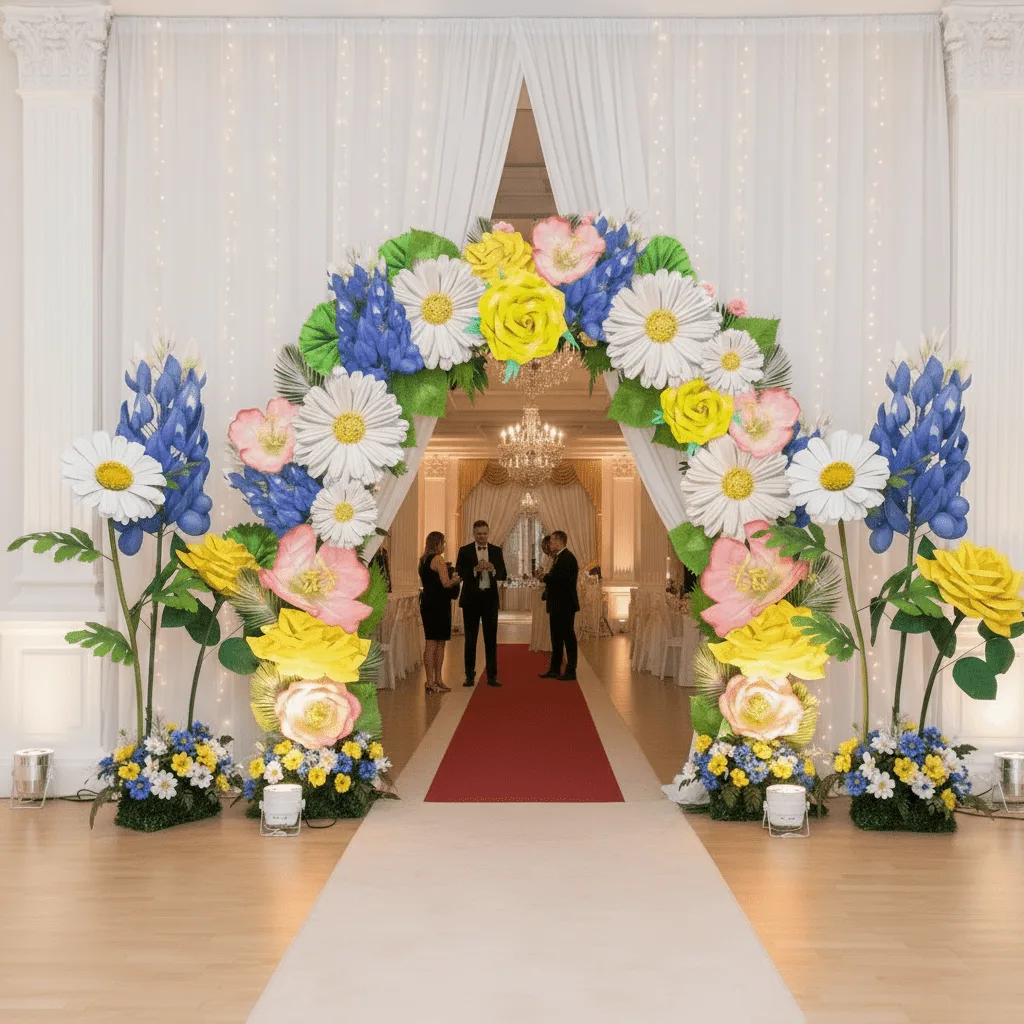
If you're building a giant flower wedding arch, you'll often need stems to curve outward from a central structure. Bend them at the base first — about a 45-degree angle — before attaching the flower head. It's much harder to bend accurately once the bloom is on.
For tight curves on thicker stems, a pair of needle-nose pliers gives you way more control than your hands alone.
Attaching Your Flower Head to Bendable Pipe Stems: Step-by-Step
Okay, this is where I see the most mistakes. People hot glue the flower head to the stem and call it done. Then it falls off at the event. Let me show you how to do this right.
Bend the top 2–3 inches of your stem into a small flat loop or spiral. This creates a larger surface area for gluing and prevents the stem from punching straight through your foam center.
Think of it like a nail with a head on it — the loop is the head that keeps everything from sliding off.
Cut a circle of 6mm EVA foam about 3–4 inches in diameter. This is your anchor disc. Apply a generous bead of low-temp hot glue to the looped stem top, then press the foam disc firmly onto it.
Hold it for a full 60 seconds. Seriously — don't rush this step. The bond needs to set completely before you add the flower head weight.
Apply hot glue to the top of your anchor disc and press your flower's center piece (the cone or rosette center) onto it. Wrap the connection point with 24-gauge floral wire, pulling firmly so it bites into the foam slightly.
Then wrap the whole joint with green or colored floral tape, stretching it as you wrap — stretched floral tape activates its adhesive and creates a much stronger seal.
Step 4: Layer On Your Petals
Now add your petals from the outside in, working toward the center. Each petal row should overlap the previous one by about 30–40%.
This is the same technique I teach in our kits — and it's the same method that's helped our flowers end up at Disney installations and Dolce & Gabbana events. The structure underneath is what makes the whole thing work.
A great stem means nothing if your base is wobbly. Here are the three base methods I use most, depending on the build.
Fill a 5-gallon bucket with floral foam, sand, or quick-set concrete. Push your stem in to a depth of at least 8–10 inches. Cover the top with moss, fabric, or decorative filler.
This is my go-to for outdoor events — it's heavy enough to handle wind and light enough to transport.
For indoor events, a tall decorative vase filled with decorative rocks or sand works beautifully. Slide the stem in and let the weight do the work. Looks elegant, hides the mechanics completely.
For permanent or semi-permanent installations, attach a pipe flange to a wooden base and thread your stem into it. This is what we use for commercial retail displays and experiential marketing activations — you can see some of those ideas in our post on experiential marketing activations.
According to Event Marketer, experiential activations with large-scale prop elements see up to 40% higher attendee engagement than standard booth setups. A properly secured giant flower is a serious marketing tool.
Common Mistakes to Avoid With Bendable Pipe Flower Stems
I've made all of these. Learn from my pain.
Function is everything, but beauty matters too. Here's how I finish stems so they look intentional and polished.
A simple wrap of satin ribbon in a coordinating color transforms a basic green stem into a design element. Secure the ribbon at the base with a small dab of hot glue, then spiral it upward, overlapping by about 50% with each pass.
EVA foam leaves cut from our 2mm foam sheets can be attached directly to the stem with hot glue. Space them about 6–8 inches apart for a natural look. Curl the leaf edges slightly with your fingers for dimension — check out our guide to every type of foam for giant flowers to pick the right foam for leaf-making.
If you want a specific color — blush, gold, white — paint the stem before attaching the flower head. Acrylic paint adheres well to most foam-wrapped stems. Our post on flawless foam board paint finishes has great tips that apply here too.
One of the best things about these stems? They last. A Brides.com survey found couples spend an average of $2,000–$2,500 on wedding flowers — flowers that wilt and get tossed within a week.
Your giant foam flowers with quality stems can be reused for dozens of events. That's an incredible return on investment, especially for event planners and small business owners.
To store stems properly, never coil them tightly — this can create permanent kinks in the wire core. Instead, store them straight or in a gentle curve in a long box or tube. I use a PVC pipe sleeve to protect mine during transport.
Disassembling flower heads from stems is easier if you used floral wire — just unwind the wire, gently warm the glue joints with a heat gun on low, and the pieces separate cleanly.
Most bendable pipe flower stems have a core of aluminum or galvanized steel wire, which gives them their flexibility and shape-holding ability. The outside is typically wrapped in a foam or paper coating — sometimes pre-colored in green or white.
The wire core is what makes them so useful for giant flower builds: it bends easily by hand, holds the position you set it in, and doesn't snap or crack the way rigid materials do.
How do I keep my giant flower from drooping on the stem?
Drooping usually comes down to two things: stem gauge too thin for the flower head weight, or a weak attachment point. Make sure you're using at least a 10mm stem for any flower head over 1 pound, and always use the anchor disc + floral wire reinforcement method described above.
If you're still getting droop, try shortening the stem slightly — a longer stem creates more leverage and makes drooping worse. Sometimes just removing 4–6 inches from the bottom solves the problem entirely.
Absolutely — in fact, they're great for wall builds too. For wall decor flower arrangements, you can bend stems into a hook shape at the back and hang them on nails or command strips, or wire them to a grid panel.
The flexibility means you can angle each flower slightly differently, creating a much more dynamic wall display than you'd get with rigid stems.
For a standard 6–8 foot wedding arch, plan on 20–30 stems if you're doing a full floral coverage look, or 8–12 stems for a more minimal, statement-flower style. Our post on oversized flower arch backdrops walks through the planning in detail.
Always buy a few extra stems — they're inexpensive and having spares means you can adjust your arrangement on the day without running to the store.
Where can I buy quality bendable pipe flower stems?
You can find them in our Amazing Giant Flowers shop — we carry stems specifically sized and tested for giant EVA foam builds. We also include stems in many of our Bundle Kits, so everything you need arrives together.
If you're sourcing elsewhere, look for stems with a solid wire core (not hollow) and a foam or paper wrap that won't crack when bent. Avoid cheap plastic-coated options — they look fine at first but the coating splits and looks terrible after one use.
Are bendable stems safe for outdoor events?
Yes, with the right base. The stems themselves handle outdoor conditions well — they don't rust quickly and the foam wrap is moisture-resistant. The bigger concern outdoors is wind.
For any outdoor event, use a weighted base (I recommend the bucket-and-concrete method above) and keep flowers under 4 feet tall unless you can anchor them to a structure. According to the National Weather Service, winds above 15 mph can topple unsecured lightweight structures — so always check your forecast and plan accordingly.
Getting your stems right isn't glamorous — it's not the part anyone posts on Instagram. But it's the foundation that makes everything else possible. When your stems are properly sized, shaped, and attached, your flowers look incredible and stay that way through an entire event, a photoshoot, or a retail display that runs for weeks. If you're ready to build something amazing, come check out our kits and supplies at Amazing Giant Flowers. Everything I've described in this tutorial is what goes into every kit we ship — pre-cut pieces, the right stems, and video tutorials so you're never guessing. I'd love to see what you create. What kind of build are you planning? Drop it in the comments — I read every single one.
Ready to Create Something Amazing?
Browse our collection of giant flower kits and start your next project today.