Instagram Event Photography: How to Shoot Giant Flowers Like a Pro
If you've ever spent hours setting up the most beautiful giant flower display — petals perfectly shaped, colors coordinated, stems standing tall — and then taken a photo that looks completely flat and sad on Instagram, you are not alone. Learning real Instagram event decor photography tips changed everything for me and for so many of my customers who use our giant EVA foam flowers at weddings, parties, and brand activations.
Here's the thing: your flowers aren't the problem. Your camera isn't the problem either. It's almost always the light, the angle, or the background. And once you know what to look for? You'll never take a bad flower photo again.
Key Takeaways
I'm going to walk you through exactly how I shoot our giant flowers — the same techniques I use when we're creating content for our own feed and the same advice I give to event planners and brides who want their displays to stop people mid-scroll. Let's get into it.
Real flowers are stunning in person. But photographically? They're a nightmare. Petals wilt, colors shift under artificial light, and intricate details blur into a muddy mess on camera.
Giant EVA foam flowers don't do any of that. They hold their shape, they're bold enough to read from across a room, and they photograph beautifully in almost any lighting condition. That's honestly one of the reasons I fell in love with making them.
Our flowers range from 2 to 5 feet tall, which means they fill a frame naturally. You don't have to fight for visual impact — it's already built in.
The Numbers That Should Motivate You
According to Sprout Social, Instagram posts with high visual contrast get up to 38% more engagement than low-contrast images. That stat lives rent-free in my head every time I'm setting up a shot.
A Statista report shows Instagram has over 2 billion monthly active users. The event and wedding space is one of the most competitive niches on the platform — your decor photos need to work harder than ever.
So let's make sure your giant flowers do exactly that.
I'm not going to tell you to "find good light" and leave it at that. That's the kind of advice that sounds helpful and means absolutely nothing. Let me actually break this down into situations you'll actually encounter.
Natural light is your best friend. Full stop. If you're shooting indoors, position your flower display within 6 to 10 feet of a large window. You want the light coming from the side — not directly behind the flowers, not blasting straight at them from the front.
Side lighting creates dimension. It catches the curves of each petal and creates those gorgeous soft shadows that make a 2D photo feel three-dimensional. If the window light is too harsh and creating bright hot spots, hang a white sheet or tape a piece of white tissue paper over the glass. Instant diffuser, zero cost.
Outdoor Events and Golden Hour
If you're at an outdoor event, golden hour is non-negotiable. That's the hour after sunrise or the hour before sunset. The light is warm, diffused, and flattering on literally everything — but especially on flowers.
Midday sun is brutal. It bleaches colors, creates harsh shadows under petals, and makes even the most beautiful arrangement look cheap. If you have to shoot at midday, find open shade — under a tent, beside a building, anywhere that blocks direct overhead sun.
For evening events with artificial lighting, this is where it gets tricky. Warm LED lights (around 3000K color temperature) are your ally. They make pinks look lush and whites look creamy.
Avoid cool fluorescent lighting at all costs — it turns every color slightly green and makes foam flowers look plastic instead of lush. If you can't control the venue lighting, bring a small LED ring light or a portable warm-toned panel light (available for around $30–$60 on Amazon) and position it at a 45-degree angle to the display. It makes an enormous difference.
Most people photograph flower displays straight on, standing at eye level. And honestly? That's the most boring angle. Here's what I actually do — and what I teach every event planner who asks me for Instagram event decor photography tips.
I always shoot at least three different angles for every display: one wide establishing shot, one mid-range showing the full arrangement, and one tight detail shot. That gives you content variety for multiple posts without moving anything.
If you're creating a flower arch backdrop specifically for photos, think about the angles before you even start building. Where will people stand? What's behind them? What's the light source? Build the arch to work with your shooting position, not the other way around.
Composition Rules (And When to Break Them)
Here's something I learned the hard way: composition is what separates a snapshot from a photograph. You don't need to go to art school. You just need to know a few rules — and when to ignore them.
Imagine your frame divided into a 3x3 grid. Place your main flower — or the focal point of your arrangement — at one of the four intersection points of that grid, not dead center. It creates visual tension in the best possible way.
Most phones have a grid overlay option in the camera settings. Turn it on. Use it every single time. It takes about ten seconds to enable and it will immediately improve every photo you take.
Leading lines are your secret weapon at events. A long banquet table, a row of freestanding giant flower arrangements, a staircase railing — these all create lines that draw the eye into the frame and toward your flowers.
Negative space is something most people are afraid to use. But leaving 30–40% of your frame as empty sky, wall, or floor actually makes your flowers feel bigger and more dramatic. It's counterintuitive. It works every time.
When do you break the rules? When something feels right. If centering a single giant dahlia in the middle of the frame makes it look like a portrait — do it. Rules exist to give you a foundation, not a cage.
According to Later's Instagram engagement research, images with a clear focal point consistently outperform cluttered compositions. One hero flower. Clean background. Strong light. That formula works every single time.
For wedding and event setups, I always recommend having a dedicated photo moment built into the design — a single arch or backdrop positioned specifically for guest photos. Our giant flower wedding arch guide walks through exactly how to design for photography first.
Editing Your Event Decor Photos for Instagram

Okay, you've taken the shot. Now let's make it sing.
Editing is not cheating. Every professional photographer edits. Every brand edits. The goal isn't to make something fake — it's to make the photo look the way the display actually felt in person. Because cameras lie. They flatten and dull everything.
I use Lightroom Mobile for serious editing and VSCO for quick consistent filters. Both are free to start and both are miles ahead of Instagram's built-in editing tools.
Real talk: consistency matters more than perfection. Pick a color palette and stick to it across your feed. If your giant flowers are blush and cream, your editing should lean warm and soft. If you're going bold tropical colors, lean into saturation and contrast. Your feed should feel like a world someone wants to live in.
A HubSpot marketing study found that consistent visual branding increases revenue by up to 23% for small businesses. For event planners and decorators, your Instagram IS your portfolio — it's often the first and only thing a potential client sees before they decide to reach out.
Captions matter more than most people think. Don't just post a pretty picture and walk away. Tell the story — where was this event, what size flowers did you use, how long did setup take? People are nosy in the best way. They want the behind-the-scenes details, and sharing them builds real trust with your audience.
End every caption with a question or a call to action. "Which color combo is your favorite?" or "Save this for your next event!" drives comments and shares, which signals to Instagram's algorithm that your content is worth pushing further.
Hashtag Strategy That Actually Works
Hashtags are still worth using, but be strategic. Mix broad tags like #eventdecor and #weddingflowers with niche tags like #giantpaperflowers, #foamflowers, and location-based tags like #houstonwedding or #dallaswedding.
According to Sprout Social's hashtag research, posts using 3 to 5 targeted hashtags consistently outperform posts using 20+ broad ones. Quality over quantity — every time.
Video content is performing better than ever. A quick 15-second Reel showing your giant flower setup process — foam sheets to finished display — gets incredible reach right now. I've seen simple setup videos outperform polished photos 3 to 1 on engagement. Don't overthink it. Just hit record.
If you're building backdrops specifically designed for guest photo moments, our large paper flower arch decoration guide has practical design tips for creating displays that look as good in photos as they do in person. And if you're working on a corporate activation, check out our corporate event engagement ideas post — there's a whole section on designing for social sharing.
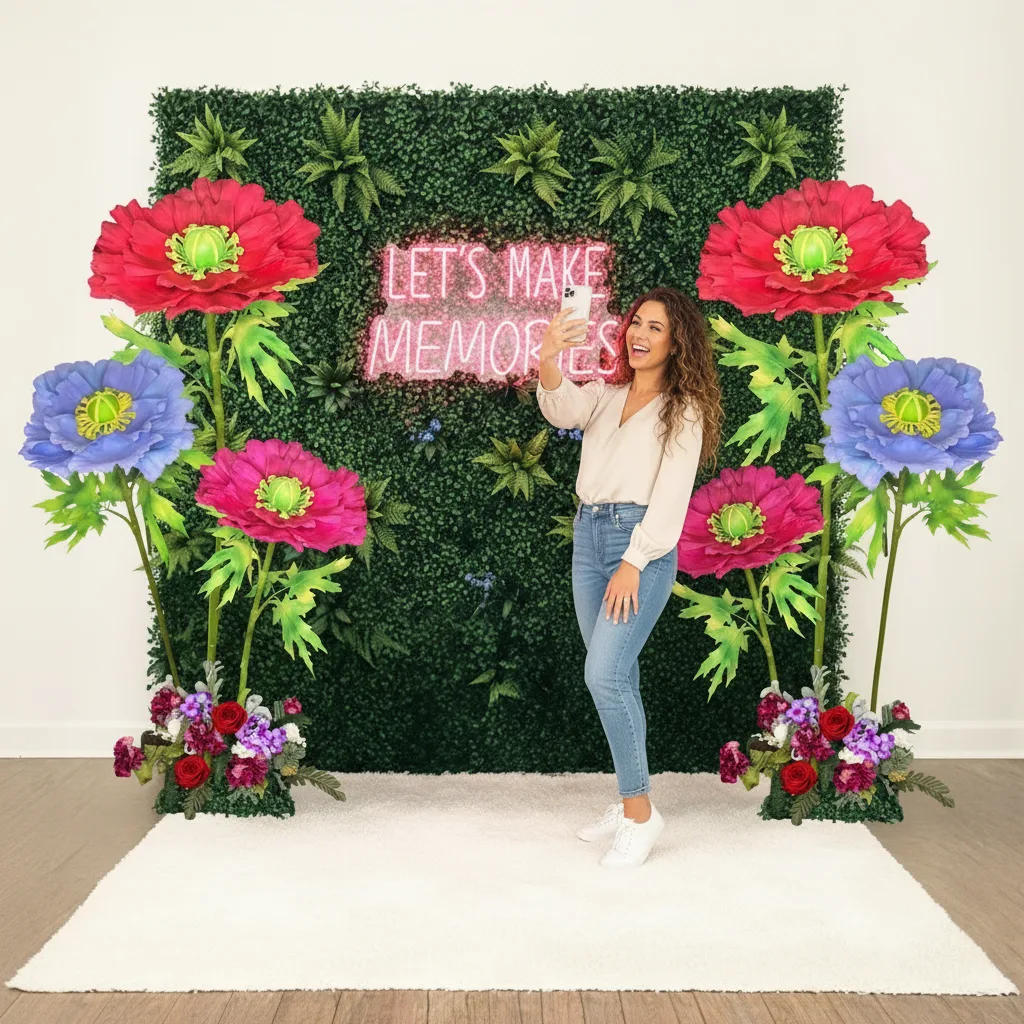
People in photos perform better than empty displays. A bride standing in front of a giant flower arch. A kid reaching up to touch a 4-foot dahlia. A brand ambassador laughing in front of a flower wall. According to Social Media Examiner, Instagram photos that include human faces receive 38% more likes than those without.
Build your displays to invite people in, not just to be admired from a distance. Think about sightlines, approach angles, and how tall your average guest is relative to the flowers. A 5-foot flower positioned at the back of a deep arch can get lost — bring it forward, make it the star.
And honestly, that's what giant flowers do better than almost any other decor element. They make people want to walk up, touch them, stand next to them, take a photo. They're interactive by nature. Lean into that when you're designing your next display.
If you're just getting started and want to build something truly photo-worthy for your next event, come browse our shop. We have everything from individual freestanding kits to full bundle kits with 8 to 12 flowers — all pre-cut, all ready to assemble with our video tutorials. You don't need to be crafty. You just need to want something beautiful.
Frequently Asked Questions

What is the best time of day to photograph event decor for Instagram?
Golden hour — the hour after sunrise or the hour before sunset — gives you the warmest, most flattering natural light for outdoor events. For indoor events, mid-morning light streaming through large windows is ideal because it's bright but not yet harsh.
If your event runs all day, do a quick scout at setup time and identify the best-lit spot in the venue. Shoot your hero display photos there during the best light window, even if the event itself hasn't started yet.
Absolutely not. A modern smartphone — iPhone 13 or later, Samsung Galaxy S21 or later — shoots more than well enough for Instagram. The biggest improvements come from lighting and composition, not camera hardware.
If you want to level up without buying a DSLR, invest in a clip-on wide-angle lens (around $15–$25) for your phone. It lets you capture full arrangements in tight spaces without distortion.
EVA foam flowers are low-maintenance, but a few things help before a shoot. Gently reshape any petals that got flattened during transport by warming them briefly with a hair dryer on low heat — the foam becomes pliable and holds a new curve beautifully. Wipe down petals with a barely damp cloth to remove any dust that catches light and creates unwanted glare.
Store your flowers upright or hanging rather than stacked flat. Flat storage over time can cause petals to lose their curve, which is the detail that makes them look lush and dimensional on camera.
What background colors work best behind giant flowers for Instagram?
Clean, solid backgrounds almost always win. White walls, cream draping, and sage green backdrops are universally flattering. The goal is contrast — if your flowers are light pink, a white background will wash them out; a deep green or dusty blue backdrop will make them pop.
Avoid busy patterned backgrounds like exposed brick or floral wallpaper unless the pattern is very subtle. The flowers should be the hero of the image, and a competing background steals focus every time.
I recommend shooting a minimum of 30 to 50 frames per display, across at least three angles and two or three lighting conditions if possible. That sounds like a lot, but it takes about 10 minutes and gives you enough variety to post consistently for two to three weeks from a single event.
Batch your editing in one sitting right after the event while everything is fresh. Export your favorites, drop them into a scheduling app like Later or Planoly, and you've got your content calendar handled without scrambling every day.
Edit separately, every time. Instagram's built-in filters are blunt instruments — they apply the same adjustments to every part of the image equally, which often ruins petal detail and shifts colors in unflattering ways. Apps like Lightroom Mobile give you precise control over highlights, shadows, vibrance, and sharpness independently.
Once you find an editing style you love, save it as a preset in Lightroom. Apply that preset to every photo before posting and your feed will have a cohesive, professional look that builds brand recognition over time.
What kind of event are you shooting next? I'd genuinely love to know — drop it in the comments or send me a message. And if you post your giant flower photos, tag us. Nothing makes my day like seeing what you all create.
Ready to Create Something Amazing?
Browse our collection of giant flower kits and start your next project today.